Regions within the infrared
In general, objects emit infrared radiation across a spectrum of wavelengths, but sometimes only a limited region of the spectrum is of interest because sensors usually collect radiation only within a specific bandwidth. Thermal infrared radiation also has a maximum emission wavelength, which is inversely proportional to the absolute temperature of object, in accordance with Wien's displacement law. The infrared band is often subdivided into smaller sections, although how the IR spectrum is thereby divided varies between different areas in which IR is employed.
Visible limitedit
Infrared, as implied by its name, is generally considered to begin with wavelengths longer than visible by the human eye. However there is no hard wavelength limit to what is visible, as the eye's sensitivity decreases rapidly but smoothly, for wavelengths exceeding about 700 nm. Therefore wavelengths just longer than that can be seen if they are sufficiently bright, though they may still be classified as infrared according to usual definitions. Light from a near-IR laser may thus appear dim red and can present a hazard since it may actually be quite bright. And even IR at wavelengths up to 1,050 nm from pulsed lasers can be seen by humans under certain conditions.
Commonly used sub-division schemeedit
A commonly used sub-division scheme is:
| Division name | Abbreviation | Wavelength | Frequency | Photon energy | Temperaturei | Characteristics |
|---|---|---|---|---|---|---|
| Near-infrared | NIR, IR-A DIN | 0.75–1.4 μm | 214–400 THz | 886–1,653 meV | 3,864–2,070 K (3,591–1,797 °C) |
Defined by water absorption,clarification needed and commonly used in fiber optic telecommunication because of low attenuation losses in the SiO2 glass (silica) medium. Image intensifiers are sensitive to this area of the spectrum; examples include night vision devices such as night vision goggles. Near-infrared spectroscopy is another common application. |
| Short-wavelength infrared | SWIR, IR-B DIN | 1.4–3 μm | 100–214 THz | 413–886 meV | 2,070–966 K (1,797–693 °C) |
Water absorption increases significantly at 1,450 nm. The 1,530 to 1,560 nm range is the dominant spectral region for long-distance telecommunications. |
| Mid-wavelength infrared | MWIR, IR-C DIN; MidIR. Also called intermediate infrared (IIR) | 3–8 μm | 37–100 THz | 155–413 meV | 966–362 K (693–89 °C) |
In guided missile technology the 3–5 μm portion of this band is the atmospheric window in which the homing heads of passive IR 'heat seeking' missiles are designed to work, homing on to the Infrared signature of the target aircraft, typically the jet engine exhaust plume. This region is also known as thermal infrared. |
| Long-wavelength infrared | LWIR, IR-C DIN | 8–15 μm | 20–37 THz | 83–155 meV | 362–193 K (89 – −80 °C) |
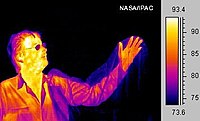
The "thermal imaging" region, in which sensors can obtain a completely passive image of objects only slightly higher in temperature than room temperature - for example, the human body - based on thermal emissions only and requiring no illumination such as the sun, moon, or infrared illuminator. This region is also called the "thermal infrared". |
| Far infrared | FIR | 15–1,000 μm | 0.3–20 THz | 1.2–83 meV | 193–3 K (−80.15 – −270.15 °C) |
(see also far-infrared laser and far infrared) |
NIR and SWIR is sometimes called "reflected infrared", whereas MWIR and LWIR is sometimes referred to as "thermal infrared". Due to the nature of the blackbody radiation curves, typical "hot" objects, such as exhaust pipes, often appear brighter in the MW compared to the same object viewed in the LW.
CIE division schemeedit
The International Commission on Illumination (CIE) recommended the division of infrared radiation into the following three bands:
| Abbreviation | Wavelength | Frequency |
|---|---|---|
| IR-A | 700 nm – 1,400 nm (0.7 μm – 1.4 μm) |
215 THz – 430 THz |
| IR-B | 1,400 nm – 3,000 nm (1.4 μm – 3 μm) |
100 THz – 215 THz |
| IR-C | 3,000 nm – 1 mm (3 μm – 1,000 μm) |
300 GHz – 100 THz |
ISO 20473 schemeedit
ISO 20473 specifies the following scheme:
| Designation | Abbreviation | Wavelength |
|---|---|---|
| Near-Infrared | NIR | 0.78–3 μm |
| Mid-Infrared | MIR | 3–50 μm |
| Far-Infrared | FIR | 50–1,000 μm |
Astronomy division schemeedit
Astronomers typically divide the infrared spectrum as follows:
| Designation | Abbreviation | Wavelength |
|---|---|---|
| Near-Infrared | NIR | 0.7 to 2.5 μm |
| Mid-Infrared | MIR | 3 to 25 μm |
| Far-Infrared | FIR | above 25 μm. |
These divisions are not precise and can vary depending on the publication. The three regions are used for observation of different temperature rangescitation needed, and hence different environments in space.
The most common photometric system used in astronomy allocates capital letters to different spectral regions according to filters used; I, J, H, and K cover the near-infrared wavelengths; L, M, N, and Q refer to the mid-infrared region. These letters are commonly understood in reference to atmospheric windows and appear, for instance, in the titles of many papers.
Sensor response division schemeedit
A third scheme divides up the band based on the response of various detectors:
- Near-infrared: from 0.7 to 1.0 μm (from the approximate end of the response of the human eye to that of silicon).
- Short-wave infrared: 1.0 to 3 μm (from the cut-off of silicon to that of the MWIR atmospheric window). InGaAs covers to about 1.8 μm; the less sensitive lead salts cover this region.
- Mid-wave infrared: 3 to 5 μm (defined by the atmospheric window and covered by indium antimonide InSb and mercury cadmium telluride HgCdTe and partially by lead selenide PbSe).
- Long-wave infrared: 8 to 12, or 7 to 14 μm (this is the atmospheric window covered by HgCdTe and microbolometers).
- Very-long wave infrared (VLWIR) (12 to about 30 μm, covered by doped silicon).
Near-infrared is the region closest in wavelength to the radiation detectable by the human eye. mid- and far-infrared are progressively further from the visible spectrum. Other definitions follow different physical mechanisms (emission peaks, vs. bands, water absorption) and the newest follow technical reasons (the common silicon detectors are sensitive to about 1,050 nm, while InGaAs's sensitivity starts around 950 nm and ends between 1,700 and 2,600 nm, depending on the specific configuration). No international standards for these specifications are currently available.
The onset of infrared is defined (according to different standards) at various values typically between 700 nm and 800 nm, but the boundary between visible and infrared light is not precisely defined. The human eye is markedly less sensitive to light above 700 nm wavelength, so longer wavelengths make insignificant contributions to scenes illuminated by common light sources. However, particularly intense near-IR light (e.g., from IR lasers, IR LED sources, or from bright daylight with the visible light removed by colored gels) can be detected up to approximately 780 nm, and will be perceived as red light. Intense light sources providing wavelengths as long as 1,050 nm can be seen as a dull red glow, causing some difficulty in near-IR illumination of scenes in the dark (usually this practical problem is solved by indirect illumination). Leaves are particularly bright in the near IR, and if all visible light leaks from around an IR-filter are blocked, and the eye is given a moment to adjust to the extremely dim image coming through a visually opaque IR-passing photographic filter, it is possible to see the Wood effect that consists of IR-glowing foliage.
Telecommunication bands in the infrarededit
In optical communications, the part of the infrared spectrum that is used is divided into seven bands based on availability of light sources transmitting/absorbing materials (fibers) and detectors:
| Band | Descriptor | Wavelength range |
|---|---|---|
| O band | Original | 1,260–1,360 nm |
| E band | Extended | 1,360–1,460 nm |
| S band | Short wavelength | 1,460–1,530 nm |
| C band | Conventional | 1,530–1,565 nm |
| L band | Long wavelength | 1,565–1,625 nm |
| U band | Ultralong wavelength | 1,625–1,675 nm |
The C-band is the dominant band for long-distance telecommunication networks. The S and L bands are based on less well established technology, and are not as widely deployed.


Comments
Post a Comment